Please pray for me and my brother priests!

Friday, February 16, 2007

Surprised? Where have you been?

This article was from Couric and Company was linked to by Ignatius Insight. It speaks of the surprise of one CBS newsman at hiring by the John Edwards Campaign of two women who had published online hateful and bigoted screeds against the Church, Our Lord and Lady, and the Pope. Haven't heard much about this? The media didn't deem it very news-worthy. In an age when an editorial cartoon depicting Muhammad as a homicide bomber sets off international crisis, one would thing that an attack on the worlds largest Church that makes the cartoon incident pale in comparison would at least be of interest to the press.

Not so, however, for this attack is deemed acceptable. Why? The Church stands against western modernism, liberalism and secularism, (adherence to which is the very creed of the western press, and western thought for that matter.) I don't believe that the Edwards Camp didn't vett these two women properly. I believe their views and writings were known, and simply dismissed as unimportant. Why? When this all "came to light," these two women were not fired, but simply resigned. Edwards didn't offer as much as a weak reprimand. If they had written anti-Semitic tracts, or had even given the appearance of attacking Islam, would the reaction had been the same? Of course not. (All hateful attacks should be condemned loudly.) Only the Church may be attacked safely and without reprisal.

The Church will though ride out the waves of this latest storm. Why? Christ has told us as much. The gates of hell, and any attack the devil may launch against the Barque of Peter, will not bring her down. She will ride out the storm. Battered and bruised as she may be at the other side of this latest squall, we have divine assurance that she will not at the end simply be the last one standing, but the only one standing.

Questions and comments are welcome.

God love you,
Father V.
************


The Last Acceptable Prejudice
Posted by Greg Kandra


Well, it looks like the kerfuffle over John Edwards’ bloggers has blown over. They’ve both quit. But he certainly didn’t help matters. Edwards evidently hired people whose previously published comments in the blogosphere were, to put it mildly, distasteful. In fact, I’ll go one step further. They were offensive – especially to Catholics, some of whom were unstinting in their condemnation of Edwards and his employees.

It goes without saying that Edwards should have vetted these people better and displayed a little curiosity about what they had written, and what they believed. (Or, perhaps, he did vet them, did read what they had written, and didn’t see a problem with it – which opens a whole other can of worms and calls into question Edwards’ judgment.)

But the episode has drawn attention to an issue that strikes close to my own life – and the lives of about 60 million other Americans. It involves a particularly insidious form of bigotry, and the nagging suspicion that there is one remaining permissible prejudice in America. It is anti-Catholicism.

I say this as a person who has spent a quarter of a century working in network news, and as a man who, in three months, will become an ordained member of the Catholic clergy. (On May 19th I’ll be ordained a permanent deacon.) Straddling these two worlds, I’ve seen my share of controversies, scandals and public outcries over the Church and how it is treated by both the public and the media. But the Edwards debacle is something I never quite anticipated.

I would not have believed that a candidate for President (and a previous candidate for Vice President) would have hired a writer, Melissa McEwan, who had described President Bush’s supporters as a “wingnut Christofacist base.” I did not think a person of Edwards seriousness and experience would condone welcoming onto his payroll a second writer, Amanda Marcotte, who wrote on her blog “the Catholic church is not about to let something like compassion for girls get in the way of using the state as an instrument to force women to bear more tithing Catholics.” This is also the writer who wrote: “What if Mary had taken Plan B after the Lord filled her with his hot, white, sticky Holy Spirit? You’d have to justify your misogyny with another ancient mythology.” (And then there’s this pearl of wisdom: One thing I vow here and now–you motherf*** who want to ban birth control will never sleep. I will f*** without making children day in and out and you will know it and you won’t be able to stop it. Toss and turn, you mean, jealous motherf****. I’m not going to be “punished” with babies. Which makes all your efforts a failure. Some non-procreating women escaped. So give up now. You’ll never catch all of us. Give up now.”)

I certainly would not have imagined that a serious candidate for President would have kept on his payroll people who write things so blatantly, outrageously hateful towards a particular religion.

Which begs the question: would he have been so sanguine if they had written demeaning and insulting tirades about Jews? Or Muslims? How about Mormons?

But we live in an age when the culture defends artists who place a crucifix in urine, display it in a museum, and call it art. (Do that with the Koran, of course, and it’s an act of war.) We live in a time when an artist can cover an image of the Virgin Mary with dung and be celebrated. But if you merely show a cartoon of Mohammed, you provoke an international incident.

I don’t know if Edwards is a bigot. I suspect not. I suspect he’s probably just a product of his age, and that he suffers from what moral theologians would call invincible ignorance.

In other words, he’s just too ignorant to know better.

And he’s just doing what so many others have done, and continue to do: tolerating the last acceptable prejudice.

Wednesday, February 14, 2007

Funny Video!

I saw this video a long time ago, and just stumbled across it again. I offer it for your enjoyment!

God love you,
Father V.
************

Gifts in Unexpected Places

As I sit in my office snowed in due to our first Nor'Easter of the season, I came across this truly wonderful story that I thought my readers might like. It will definitely bring a smile to your faces. God gives us gifts in the most unexpected places, and people.

This article is from Catholic Online.

God love you,
Father V.
************


Handicapped ‘master’ missionary rosary maker gives back to God


By Jennifer Willems2/12/2007
The Catholic Post

GENESEO, Ill. (The Catholic Post) – Eddie DePauw will never cure cancer. He won’t lead the stock market to a record-breaking rally and he will never be elected to office. Born with Down syndrome, his gift is much simpler but it still has the potential to change lives around the world.
DePauw, 44, is a "master missionary rosary maker." As a member of the Rosary Makers of St. Malachy Church here, he has been responsible for helping the group send approximately 3,200 missionary rosaries to people in hospitals, nursing homes and adoration chapels in the United States as well as missions in Africa, the Philippines, Brazil and India over the last seven years.

"I think we formed the group for Eddie and for the blessed mother, so he could give something back," said Jolene Thompson, a member of the Rosary Makers. "His rosaries are definitely blessed."

Part of a national organization known as Our Lady’s Rosary Makers, which is based in Louisville, Ky., the Rosary Makers of St. Malachy’s Church create two kinds of rosaries.

The first are chained rosaries, which are sold to help the group buy materials and ship what they have made to the missions. Thompson noted that these rosaries require some practice and skill to make.

The second kind of rosaries the group makes is cord rosaries, which are knotted. These are the rosaries at which Eddie is a master.

"The missionary rosary is fairly simple," Thompson told The Catholic Post. "There’s a knot you have to learn between the decades but that’s not very complicated."

Jeanette DePauw, Eddie’s mother, said the repetition is what makes it possible for Eddie to make the rosaries so easily and with such grace. "Once you get it, you’ve got it," she explained.
Thompson provides the supplies and then lets Eddie make the rosaries in whatever colors he chooses. When asked what his favorite colors are for the rosaries, Eddie lists red, blue, white and green.

Many of those colors can be found in the World Mission Rosary, which was developed and promoted by Archbishop Fulton Sheen, whose cause for sainthood the Diocese of Peoria is promoting. The decades, made of clear, red, yellow, blue and green beads, represent different continents, according to Thompson.

Eddie received a World Mission Rosary kit for his birthday and works on them, along with all of the other rosaries he makes for the missions, at a table in his bedroom that is piled with beads and plastic crosses. Spools of white, black and brown cord rest on the television stand behind the desk, within easy reach.

Meticulous in counting and placing the beads just so, Eddie ties the knots as he moves from one decade of the rosary to the next. Having a visitor taking pictures and being bombarded by conversation all around him might have distracted another person, but Eddie – a man of action but few words – focused his full attention on what he was doing until he had a rosary made to his satisfaction.

"We’re just so amazed to see him be able to do this," Thompson told The Catholic Post. "What’s interesting for me to watch is his dexterity in working with the small beads."

Commitment is what makes Eddie such a valuable member of the Rosary Makers of St. Malachy’s Church, according to Thompson.

"He is very committed to it – he keeps us going," she said, noting that he also contributes joy and a simple faith to whatever he does.

In addition to making rosaries, Eddie bags them and puts labels on the bags to let the recipients know who has provided the prayer aids for them. He even has a say in where they’ll go.

"We give Eddie a list and say, ‘Where shall we send them?’" Thompson explained.

"We have gotten some beautiful letters back with blessings for Eddie," she said. "I always include a paragraph about Eddie and his work when we ship the rosaries out to the missions."

"Blessing" is a word that Jeanette also uses about her son, who lives with her and her husband, Julian, a retired farmer.

"He’s no different from any other handicapped person," she told The Catholic Post, "but maybe he’s more blessed because of the people who have been put into his life."

Among those special people are their neighbors in Geneseo and Port Byron, Ill., where the DePauws farmed; the Rosary Makers; and the people at Abilities Plus, Inc. in Kewanee, Ill., which provides services to children and adults with disabilities in Henry, Stark and Bureau counties. Eddie goes there three days a week.

One of Eddie’s gifts is his ability to connect with and remember the people he has met, she said, noting that when he was in school they used to say, "the superintendent is as good as the custodian to Eddie."

"When we go to church we sit in the back pew because he makes Mass a social event," according to Jeanette, who brought Eddie to the Special Persons Encounter Christ program at St. Malachy’s even when they lived in Port Byron. She taught in the program for several years.

What’s important to the DePauws, however, is that they just try to live life each day as the Lord wants them to.

"Bloom where you’re planted," Jeanette said. "That’s the same whether you’re handicapped or not."

Wednesday, January 24, 2007

Creating a Perfect People

Diogenes, over at Catholic World Report, offers this link and commentary on a blog posted by Amy Welborn regarding babies born with Downs Syndrome and the pressure their parents receive from the medical establishment to abort them.

I had read something about this same topic, not to long ago, but in a round about way. The article (from where I forget now) mentioned in an off-hand way the fact the special ed in schools around the country were being downsized due to a lack of special needs students (Downs Syndrome in particular.)

What is missed is that so much of the prenatal screening that mothers endure before the birth of (and sometimes at the risk of) their child is directed at this: pressure to abort the imperfect child. I mentioned this a while ago in a blog, but I say it again. When Hitler tried to create a race of "supermen", we called him a monster. When we do it in the name of "compassion" somehow we manage to claim for ourselves some sort of moral high road.

It was evil then, it is evil now, and no amount of smiling doctors, nurses, and social workers pushing 'perfection through abortion' in the name of compassion will change that. Quality of life is not determined by the number of minutes, days or years a person lives. Quality of life is not determined by fewest number of hardships. Quality of life is not determined by the number of blond haired, blue eyed, perfect people a society can produce. Quality of life is determined by how much one is loved, and how much love one can give. When we think that all people were loved so much by God that He sent His only Son to shoulder the penalty for their sins so that they might share in Paradise, we can see how much each of us is individually loved, if not by our fellow man, then by God. And anyone who has ever had the gift of knowing a person with Downs Syndrome has no difficulty knowing how much love they can give.

God love you.
************


Bias

Posted by: Diogenes - Jan. 22, 2007 12:26 PM ET USA

From the Chicago Tribune (via Amy), a surprisingly fine article on Down Syndrome babies and the concerted medical pressure on mothers to ... evacuate the uterus.

Two years ago, Anita Krach of Streamwood learned that her fetus had Down
syndrome through a phone call from a perinatologist she had just met during the
tests.

Later that day, the same doctor and a genetic counselor outlined the health problems associated with the condition at every stage of life for Krach and her husband, Michael.

"There was no positive thing that was said," Krach said. "Not one."

As Krach, then 18-weeks' pregnant, left the emotional session, the genetic counselor warned her not to call a Down syndrome support group because, she said, "they'll paint a rosy picture."

Read that last sentence again. And again.

First off, the very fact that we're talking about a support group shows the persons involved can't be unaware of the hardship. But more to the point, since when does first-hand experience of a complex human situation disqualify the opinion of those who have it?

Sunday, January 21, 2007

Exclusive Inclusive Community

This great post was taken from The Curt Jester. He has a great site, and I recomend checking it out!

The problem addressed in this post is a common problem; it's all to easy to make Christ into a play thing who will do what we want Him to do, and entertain us until we put Him back into the toybox until we again feel the urge to take Him out and make Him dance. We must not make Christ more like us, but make ourselves more like Christ. We must love Him on His terms, and not our own.

Questions and comments are, as always, welcome.

God love you!
*************


Exclusive Inclusive Community

The Washington Post has an article on a church actually called "Inclusive Community" which contains Catholic priests who left to marry and other cultural Catholics who don't like the baggage of Christ's actual teachings. As is usually the case the word inclusive can easily be substituted for liberal. Their views are never inclusive enough to believe all that the magisterium of the Church teaches is true. To not deny any teachings of the faith would be inclusive, once you start snipping some of you become exclusive by the very act of excluding them.

She grew up Roman Catholic, but like millions of others, Rebecca Ortelli
came to disagree with church teachings on contraception, communion and priestly
celibacy, among other things.

Many Catholics drift away from the church or join other denominations. But Ortelli, 57, wanted to maintain both her Catholic identity and her worldview. And she didn't want to feel one was inconsistent with the other.So 20 years ago, she did what a small number of defiant Catholics are doing.

She joined a church with many lifelongCatholics of similar views, a church that borrows heavily from Catholic rituals even though it's not part of a Catholic diocese.

"I don't think I should have to give up my Catholicism. That's part of who I am. It makes me who I choose to be," said Ortelli, whose church, in Nutley, N.J., is called the Inclusive Community. "I like some of the rituals that we have. They're
important."

The cultural Catholic phenomenon is kind of like the Urban Cowboy one. People dressing up in Cowboy hats and boots who have never ridden a horse or lived on a ranch. That by performing some rituals or putting on a cowboy hat you can call yourself either a Catholic or a cowboy. In some ways this shows the power of rituals and how they shape us, but rituals ripped from their context and roots become pretty empty and devoid an any real meaning. This might explain why their services receive a whopping 15 members.

Friday, January 12, 2007

A Primer on Indulgences

I have been asked to write a blog on indulgences, and I was asked not to take it from another website. Time, however, prevents me from granting the second request! I found this "short" primer on indulgences.

In a nutshell, picture a board with nails in it. The board is our soul, the nails are our sins, and the board must be repaired. Confession removes the nails, the "actual sins." This is only the first step to repairing the board, however. Holes are left over that need to be filled and sanded, the "consequence, effect or result of our sins."

This can be done through acts of mercy, alms giving, pilgrimages, prayers, really any way in which we are working to remedy the result of our sin, both in the world and in our souls. Indulgences are one way that God gives us, though the Church, to do this. Indulgences usually involve any one, or more than one, of the above examples I gave. We express sorrow for our sins, and make up for the effects of our sins in doing these spiritual works. If this is not done in this life, it takes place in Purgatory, when we ready ourselves to enjoy the Beatific Vision, the presence of God, forever.

If the Church has the authority to forgive the eternal penalty of sin (damnation) through the sacrament of confession, it is truly a lesser task to forgive the temporal penalty for sins (our own "spackling of the holes").

I hope this is helpful, and hope the reader forgives this busy priest his "copying" transgression!


God love you!
************


Primer on Indulgences


Those who claim that indulgences are no longer part of Church teaching have the admirable desire to distance themselves from abuses that occurred around the time of the Protestant Reformation. They also want to remove stumbling blocks that prevent non-Catholics from taking a positive view of the Church. As admirable as these motives are, the claim that indulgences are not part of Church teaching today is false.

This is proved by the Catechism of the Catholic Church, which states, "An indulgence is obtained through the Church who, by virtue of the power of binding and loosing granted her by Christ Jesus, intervenes in favor of individual Christians and opens for them the treasury of the merits of Christ and the saints to obtain from the Father of mercies the remission of the temporal punishment due for their sins." The Church does this not just to aid Christians, "but also to spur them to works of devotion, penance, and charity" (CCC 1478).

Indulgences are part of the Church’s infallible teaching. This means that no Catholic is at liberty to disbelieve in them. The Council of Trent stated that it "condemns with anathema those who say that indulgences are useless or that the Church does not have the power to grant them"(Trent, session 25, Decree on Indulgences). Trent’s anathema places indulgences in the realm of infallibly defined teaching.

The pious use of indulgences dates back into the early days of the Church, and the principles underlying indulgences extend back into the Bible itself. Catholics who are uncomfortable with indulgences do not realize how biblical they are. The principles behind indulgences are as clear in Scripture as those behind more familiar doctrines, such as the Trinity.

Before looking at those principles more closely, we should define indulgences. In his apostolic constitution on indulgences, Pope Paul VI said: "An indulgence is a remission before God of the temporal punishment due to sins whose guilt has already been forgiven, which the faithful Christian who is duly disposed gains under certain defined conditions through the Church’s help when, as a minister of redemption, she dispenses and applies with authority the treasury of the satisfactions won by Christ and the saints" (Indulgentiarum Doctrina 1).

This technical definition can be phrased more simply as, "An indulgence is what we receive when the Church lessens the temporal (lasting only for a short time) penalties to which we may be subject even though our sins have been forgiven." To understand this definition, we need to look at the biblical principles behind indulgences.


Principle 1: Sin Results in Guilt and Punishment


When a person sins, he acquires certain liabilities: the liability of guilt and the liability of punishment. Scripture speaks of the former when it pictures guilt as clinging to our souls, making them discolored and unclean before God: "Though your sins are like scarlet, they shall be white as snow; though they are red like crimson, they shall become like wool" (Is. 1:18). This idea of guilt clinging to our souls appears in texts that picture forgiveness as a cleansing or washing and the state of our forgiven souls as clean and white (cf. Ps. 51:4, 9).

We incur not just guilt, but liability for punishment when we sin: "I will punish the world for its evil, and the wicked for their iniquity; I will put an end to the pride of the arrogant and lay low the haughtiness of the ruthless" (Is. 13:11). Judgment pertains even to the smallest sins: "For God will bring every deed into judgment, with every secret thing, whether good or evil" (Eccl. 12:14).


Principle 2: Punishments are Both Temporal and Eternal


The Bible indicates some punishments are eternal, lasting forever, but others are temporal. Eternal punishment is mentioned in Daniel 12:2: "And many of those who sleep in the dust of the earth shall awake, some to everlasting life and some to shame and everlasting contempt."

We normally focus on the eternal penalties of sin, because they are the most important, but Scripture indicates temporal penalties are real and go back to the first sin humans committed: "To the woman he said, ‘I will greatly multiply your pain in childbearing; in pain you shall bring forth children (Gen. 3:16).


Principle 3: Temporal Penalties May Remain When a Sin is Forgiven


When someone repents, God removes his guilt (Is. 1:18) and any eternal punishment (Rom. 5:9), but temporal penalties may remain. One passage demonstrating this is 2 Samuel 12, in which Nathan the prophet confronts David over his adultery:

"Then David said to Nathan, ‘I have sinned against the Lord.’ Nathan answered David: ‘The Lord on his part has forgiven your sin; you shall not die. But since you have utterly spurned the Lord by this deed, the child born to you must surely die’" (2 Sam. 12:13-14). God forgave David but David still had to suffer the loss of his son as well as other temporal punishments (2 Sam. 12:7-12). (For other examples, see: Numbers 14:13-23; 20:12; 27:12-14.)

Protestants realize that, while Jesus paid the price for our sins before God, he did not relieve our obligation to repair what we have done. They fully acknowledge that if you steal someone’s car, you have to give it back; it isn’t enough just to repent. God’s forgiveness (and man’s!) does not include letting you keep the stolen car.

Protestants also admit the principle of temporal penalties for sin, in practice, when discussing death. Scripture says death entered the world through original sin (Gen. 3:22-24, Rom. 5:12). When we first come to God we are forgiven, and when we sin later we are able to be forgiven, yet that does not free us from the penalty of physical death. Even the forgiven die; a penalty remains after our sins are forgiven. This is a temporal penalty since physical death is temporary and we will be resurrected (Dan. 12:2).


Principle 4: God Blesses Some People As a Reward to Others


In Matthew 9:1-8, Jesus heals a paralytic and forgives his sins after seeing the faith of his friends. Paul also tells us that "as regards election [the Jews] are beloved for the sake of their forefathers" (Rom. 11:28).

When God blesses one person as a reward to someone else, sometimes the specific blessing he gives is a reduction of the temporal penalties to which the first person is subject. For example, God promised Abraham that, if he could find a certain number of righteous men in Sodom, he was willing to defer the city’s temporal destruction for the sake of the righteous (Gen. 18:16-33; cf. 1 Kgs. 11:11-13; Rom. 11:28-29).


Principle 5: God Remits Temporal Punishments through the Church


God uses the Church when he removes temporal penalties. This is the essence of the doctrine of indulgences. Earlier we defined indulgences as "what we receive when the Church lessens the temporal penalties to which we may be subject even though our sins have been forgiven." The members of the Church became aware of this principle through the sacrament of penance. From the beginning, acts of penance were assigned as part of the sacrament because the Church recognized that Christians must deal with temporal penalties, such as God’s discipline and the need to compensate those our sins have injured.

In the early Church, penances were sometimes severe. For serious sins, such as apostasy, murder, and abortion, the penances could stretch over years, but the Church recognized that repentant sinners could shorten their penances by pleasing God through pious or charitable acts that expressed sorrow and a desire to make up for one’s sin.

The Church also recognized the duration of temporal punishments could be lessened through the involvement of other persons who had pleased God. Scripture tells us God gave the authority to forgive sins "to men" (Matt. 9:8) and to Christ’s ministers in particular. Jesus told them, "As the Father has sent me, even so I send you. . . . Receive the Holy Spirit. If you forgive the sins of any, they are forgiven; if you retain the sins of any, they are retained" (John 20:21-23).

If Christ gave his ministers the ability to forgive the eternal penalty of sin, how much more would they be able to remit the temporal penalties of sin! Christ also promised his Church the power to bind and loose on earth, saying, "Truly, I say to you, whatever you bind on earth shall be bound in heaven, and whatever you loose on earth shall be loosed in heaven" (Matt. 18:18). As the context makes clear, binding and loosing cover Church discipline, and Church discipline involves administering and removing temporal penalties (such as barring from and readmitting to the sacraments). Therefore, the power of binding and loosing includes the administration of temporal penalties.


Principle 6: God Blesses Dead Christians As a Reward to Living Christians


From the beginning the Church recognized the validity of praying for the dead so that their transition into heaven (via purgatory) might be swift and smooth. This meant praying for the lessening or removal of temporal penalties holding them back from the full glory of heaven. For this reason the Church teaches that "indulgences can always be applied to the dead by way of prayer" (Indulgentarium Doctrina 3). The custom of praying for the dead is not restricted to the Catholic faith. When a Jewish person’s loved one dies, he prays a prayer known as the Mourner’s Kaddish for eleven months after the death for the loved one’s purification.

In the Old Testament, Judah Maccabee finds the bodies of soldiers who died wearing superstitious amulets during one of the Lord’s battles. Judah and his men "turned to prayer, beseeching that the sin which had been committed might be wholly blotted out" (2 Macc. 12:42).

The reference to the sin being "wholly blotted out" refers to its temporal penalties. The author of 2 Maccabees tells us that for these men Judah "was looking to the splendid reward that is laid up for those who fall asleep in godliness" (verse 45); he believed that these men fell asleep in godliness, which would not have been the case if they were in mortal sin. If they were not in mortal sin, then they would not have eternal penalties to suffer, and thus the complete blotting out of their sin must refer to temporal penalties for their superstitious actions. Judah "took up a collection, man by man, to the amount of two thousand drachmas of silver and sent it to Jerusalem to provide for a sin offering. In doing this . . . he made atonement for the dead, that they might be delivered from their sin" (verses 43, 46).

Judah not only prayed for the dead, but he provided for them the then-appropriate ecclesial action for lessening temporal penalties: a sin offering. Accordingly, we may take the now-appropriate ecclesial action for lessening temporal penalties— indulgences—and apply them to the dead by way of prayer.

These six principles, which we have seen to be thoroughly biblical, are the underpinnings of indulgences. But, the question of expiation often remains. Can we expiate our sins—and what does "expiate" mean anyway?

Some criticize indulgences, saying they involve our making "expiation" for our sins, something which only Christ can do. While this sounds like a noble defense of Christ’s sufficiency, this criticism is unfounded, and most who make it do not know what the word "expiation" means or how indulgences work.

Protestant Scripture scholar Leon Morris comments on the confusion around the word "expiate": "[M]ost of us . . . don’t understand ‘expiation’ very well. . . . [E]xpiation is . . . making amends for a wrong. . . . Expiation is an impersonal word; one expiates a sin or a crime" (The Atonement [Downers Grove: InterVarsity, 1983], 151). The Wycliff Bible Encyclopedia gives a similar definition: "The basic idea of expiation has to do with reparation for a wrong, the satisfaction of the demands of justice through paying a penalty."

Certainly when it comes to the eternal effects of our sins, only Christ can make amends or reparation. Only he was able to pay the infinite price necessary to cover our sins. We are completely unable to do so, not only because we are finite creatures incapable of making an infinite satisfaction, but because everything we have was given to us by God. For us to try to satisfy God’s eternal justice would be like using money we had borrowed from someone to repay what we had stolen from him. No actual satisfaction would be made (cf. Ps. 49:7-9, Rom. 11:35). This does not mean we can’t make amends or reparation for the temporal effects of our sins. If someone steals an item, he can return it. If someone damages another’s reputation, he can publicly correct the slander. When someone destroys a piece of property, he can compensate the owner for its loss. All these are ways in which one can make at least partial amends (expiation) for what he has done.

An excellent biblical illustration of this principle is given in Proverbs 16:6, which states: "By loving kindness and faithfulness iniquity is atoned for, and by the fear of the Lord a man avoids evil" (cf. Lev. 6:1-7; Num. 5:5-8). Here we are told that a person makes temporal atonement (though never eternal atonement, which only Christ is capable of doing) for his sins through acts of loving kindness and faithfulness.


NIHIL OBSTAT: I have concluded that the materials
presented in this work are free of doctrinal or moral errors.
Bernadeane Carr, STL, Censor Librorum, August 10, 2004

IMPRIMATUR: In accord with 1983 CIC 827
permission to publish this work is hereby granted.
+Robert H. Brom, Bishop of San Diego, August 10, 2004

Sunday, January 7, 2007

Elizabeth Fox-Genovese

Another great culture warrior has fallen. I was first exposed to Elizabeth Fox-Genovese through her book The War Against Boys, a fine book that I highly recomend. She was a great speaker, a great author, and a woman of deep faith.
I take this short obituary from the website Catholics in the Public Square.
In paradisum deducant te Angeli; in tuo adventu suscipiant te martyres, et perducant te in civitatem sanctam Jerusalem. Chorus angelorum te suscipiat, et cum Lazaro quondam paupere æternam habeas requiem.
Requiem in pace.


Elizabeth Fox Genovese 1941-2007
Posted by Christopher at 6:42 PM


Elizabeth Fox Genovese died on January 2nd, at the age of 65. The blog Cosmos Liturgy Sex provides a welcome roundup of memories and tributes - In Memory of Elizabeth Fox-Genovese: Secular, Liberal to Pro-life Feminist:

Elizabeth began her career as an atheist, feminist scholar but her sharp mind and open heart soon led her to the truth about abortion and eventually to her conversion to the Catholic Faith. She was an active member of the Fellowship of Catholic Scholars, a recognized expert in the history of the American South, and a critic of radical feminism.Elizabeth offered some reflections on her conversion in a Crisis 2002 magazine article, The Way of Conversion:

What I believe I can say with some confidence, but without pride, is that conversion never stops. Each day, each of us faces fresh challenges to live and act and speak in fidelity to the gospel, and none of them is easy.

But of this we may be sure: If we back away from all of them and retreat into the comfort of the prevailing consensus, we will lose the substance of our conversion. It is common to see the convert as the prodigal son of Jesus' parable and, I suspect, no less common for faithful Catholics, including converts, to identify with the older son, for whom no fatted calf is killed. In slipping into that view of ourselves as having been converted-having attained a status-we lose sight of the parable's deeper meaning: namely, that we always remain the prodigal son and always remain in need of the Father's unqualified welcome.

Saturday, January 6, 2007

Our Toys

In the spirit of my last blog, and simply because I love this poem for its beauty and truth (is there any other reason to love a thing?) I submit to you Our Toys for your reflection.

I first heard this poem recited by Archbishop Fulton Sheen during a retreat talk I have on audio tape. It speaks to the truth of man's relationship with Christ and religion. To often too many of us, even those who would never think so, play at religion without really realizing the implications of what we pray for and what we believe. We often attempt to make Christ over into our own image, rather than allowing Him to make us over in His. The former leads to spiritual laxity, pride, and eventually hell. The latter leads to joy, peace, faith, hope, love, and heaven. The former leads to a cross of despair, the latter leads to the cross of hope and resurrection.
This was brought home to me by a friend who is going through RCIA right now. She was baptized as a child, and received none of the other sacraments. She is now delving into her religion with such seriousness and faith as to be an example to us all. She commented on the theme of Advent, "Come Lord Jesus" with this surprising insight. To paraphrase, she said, "I am not ready for Him to come yet, and praying for it makes me nervous."
Wow. Only a believer, who knows the power of prayer, and the power of her prayer, would say something like that. "Reality would only add to our unrest." (I also owe this person a blog on indulgences that I have not forgotten about!)
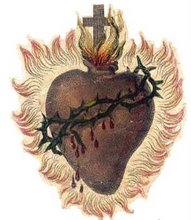
Let us take Christ as He is, and allow Him to make our hearts more like His Sacred Heart, pierced for love of a fallen world, so that what the Father sees and loves in Him, He may see and love in us.
God love you!
************


Our Toys

A blithe infant, lapped in careless joy
sports with a woolen lion. If the toy
should come to life, the child so direly crossed
to face with this reality were lost.

Leave us our toys, then; happier we shall stay
while they remain but toys, and we can play
with them and do with them as suits us best.
Reality would only add to our unrest.

We want no living Christ, whose Truth intense
pretends to no belief in our pretense,
and flashing on all folly and deceit
would blast our world to ashes at our feet.

We want no more of Him than is displayed
in the dead plaything our own hands have made
to lull our fears and comfort us in loss:
a plastic Christ upon a plastic cross.


Padre Miguel Pro preparing for the firing squad.
His crime: being a priest
.


Padre Pro waiting for the squad to fire.
His dying words: "Viva Christo Rey!- Long live Christ the King!

Plaster Saints


This is a great short article offered by Catholic News Agency about the Holy Father's general audience reflection of Christmas. In the 5th paragraph, the columnist offers the Holy Father's words in regard to Christ's divinity.

I was with our parish men's group (a fine bunch of faithful, prayerful guys) and this topic was raised. There is a danger in disassociating the baby Jesus of Christmas with the suffering Christ of Good Friday. We can't forget for what this babe was born for: to suffer and die for our sins in order to restore divine friendship to man. There is great reason to rejoice in His birth, for it marks the beginning of our redemption. However, the rejoicing is empty without the redemption, that came at great price, of Calvary.

I worry sometimes about the "safe" image of Christ on Christmas. (I am not a humbug type, either!) However, we can't turn Jesus, Mary, or Joseph into pious legend that we drag out once a year to make us feel good, then return the statues of the nativity scene to their box, not to drag them out again until it's time for Santa next year. Jesus, Mary and Joseph live; St. Joseph's soul rests with the righteous in heaven, and Jesus and Mary live in their glorified bodies as a foretaste and assurance of the promise made to all of us. In fact, not only are they "real", but are indeed more real than me writing this blog, and more real than all of you reading it.


May the innocence, joy, peace and purity of the Christ-child be with you all the year, and may the memory of this joyful event strengthen you in bearing your crosses.


God love you!

Pope Benedict reflects again on the gift of Christmas


The nativity scene in St. Peter's Square, Vatican City.


Vatican City, Jan. 03, 2007 (CNA) - In his first general audience of this year, held this morning in the Vatican's Paul VI Hall, the Pope Benedict XVI pointed out how the atmosphere of Christmas "invites us to rejoice for the birth of the Redeemer."

Referring to the gift of Christmas, the Holy Father said, "Those who pause in meditation before the Son of God lying defenseless in the manger cannot but marvel at this humanly incredible event; they cannot but share the wonder and the humble abandonment of the Virgin Mary, whom God chose as the Mother of the Redeemer precisely because of her humility.”

"In the Child of Bethlehem," the Pope added, "all mankind discovers itself to be gratuitously loved by God. In the light of Christmas, the infinite goodness of God is made plain to each of us. In Jesus, the heavenly Father inaugurated a new relationship with us: He made us 'sons in the Son'."
"However, the joy of Christmas does not make us forget the mystery of evil (mysterium iniquitatis), the power of the dark that seeks to obscure the splendor of divine light, and unfortunately we experience this power of darkness every day. ... This is the drama of the rejection of Christ which, today as in the past, shows and expresses itself in many different ways."

Indeed, he continued, "perhaps the ways of refusing God in the modern age are even more insidious and dangerous: from outright rejection to indifference, from scientistic atheism to the presentation of a modernized or post-modernized Jesus, a human Jesus, reduced in various ways to being a simple man of His time and deprived of His divinity; or perhaps a Jesus so idealized as to appear as a character of legend."

Yet, Pope Benedict said, "only the Child lying in the manger possesses the real secret of life. For this reason He asks for acceptance, for space to be made for Him among us, in our hearts, in our houses, in our cities and in our societies," In this "we are helped by the simplicity of the shepherds and the quest of the Magi, who through the star scrutinized the signs of God, [and by] the docility of Mary and the prudent wisdom of Joseph."

"At the beginning of this new year, let us reawaken our commitment to open our minds and hearts to Christ, sincerely demonstrating to Him our will to live as His true friends. Thus will we become collaborators in His plan of salvation and witnesses of the joy He brings, that we may spread it abundantly about us.”

“Let us accompany Jesus, walk with Him, and thus the new year will be happy and good," the Pope concluded.

Monday, December 25, 2006

Venite Adoremus

Merry Christmas to my readers! I include below the words to "O Holy Night," which is my favorite Christmas Carol, for your enjoyment (and reflection) today.
God love you and Merry Christmas!
************

Merry Christmas!
O Holy Night

O holy night, the stars are brightly shining;
It is the night of the dear Savior’s birth!
Long lay the world in sin and error pining,
Till He appeared and the soul felt its worth.
A thrill of hope, the weary soul rejoices,
For yonder breaks a new and glorious morn.
Fall on your knees, O hear the angel voices!
O night divine, O night when Christ was born!
O night, O holy night, O night divine!

Led by the light of faith serenely beaming,
With glowing hearts by His cradle we stand.
So led by light of a star sweetly gleaming,
Here came the wise men from Orient land.
The King of kings lay thus in lowly manger,
In all our trials born to be our Friend!
He knows our need—to our weakness is no stranger.
Behold your King; before Him lowly bend!

Truly He taught us to love one another;
His law is love and His Gospel is peace.
Chains shall He break for the slave is our brother
And in His Name all oppression shall cease.
Sweet hymns of joy in grateful chorus raise we,
Let all within us praise His holy Name!
Christ is the Lord! O praise His name forever!
His pow’r and glory evermore proclaim!